
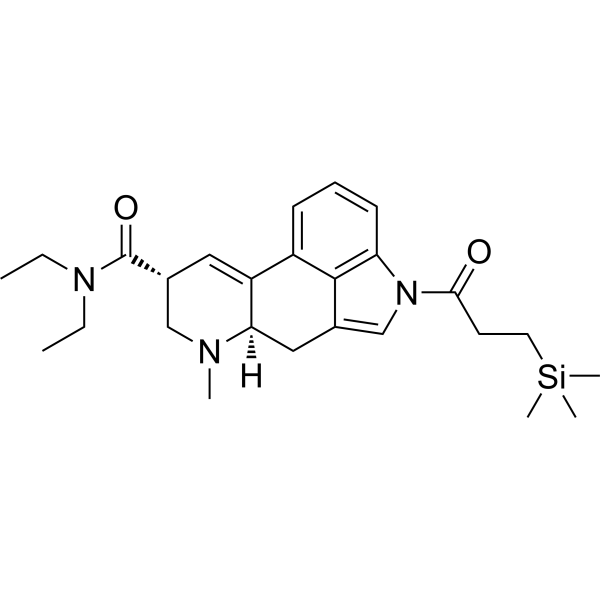
What is 1S-LSD, 1-(3-(trimethylsilyl)propionyl)-LSD
1S-LSD, also known as 1-(3-(trimethylsilyl)propionyl)-LSD, is a psychedelic drug of the lysergamide family related to lysergic acid diethylamide (LSD).
It is the trimethylsilyl derivative of 1P-LSD and functions as a prodrug and functional analogue of LSD.
1S-LSD was developed in response to legal restrictions on similar compounds, such as 1D-LSD, which were banned in Germany under the NpSG law in June 2024.
The compound was introduced as a legal alternative by incorporating a trimethylsilyl group, which is not covered under current NpSG regulations.
This chemical modification allows 1S-LSD to be legally sold in Germany as of September 2024.
It is typically distributed in its hemi-D-tartrate form, a common format for lysergamides due to its stability and ease of use.
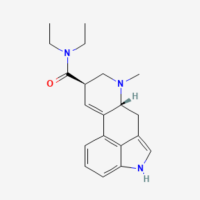
1S-LSD belongs to the lysergamide class of compounds, which are characterized by the ergoline structure derived from lysergic acid.
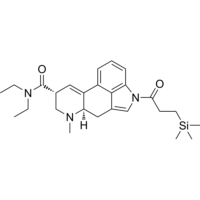
The compound is closely related to LSD and 1P-LSD but differs by the addition of a trimethylsilyl group on the propionyl chain.
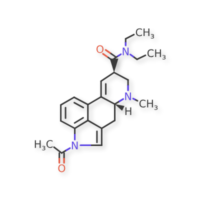
The nitrogen atom in the polycyclic indole group of the ergoline structure is a common site for chemical modifications, as it is highly reactive and accessible for various reactions.
These modifications often include alkylations, acylations, Mannich reactions, and Michael additions. Such alterations are frequently explored in the synthesis of new analogues to modify pharmacological properties or evade legal controls.
The addition of the trimethylsilyl group in 1S-LSD represents a strategic modification designed to keep the substance outside the coverage of Germany’s New Psychoactive Substances Act (NpSG).
Despite these changes, 1S-LSD likely retains a pharmacological profile similar to that of LSD, acting primarily as a serotonergic hallucinogen.
Reviews
There are no reviews yet.